
As the global adoption of new energy vehicles accelerates, public charging infrastructure continues to expand, and charging authorization methods are becoming increasingly diverse. With the widespread use of mobile wallets, contactless cards, and even wireless technology, many drivers and industry observers are asking: Is an EV charging RFID Card still a necessary tool for public charging stations?
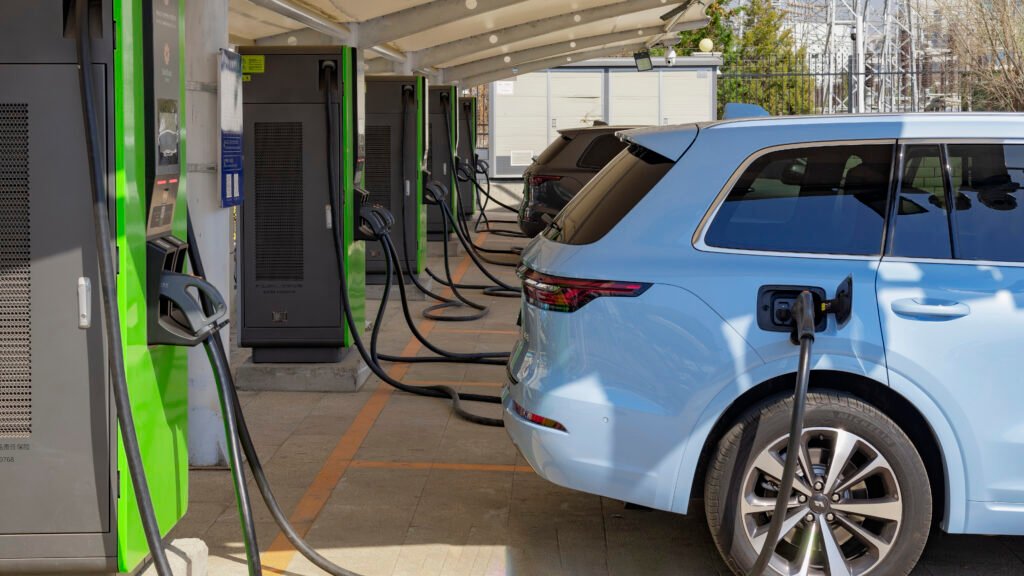
The answer is not absolute. While RFID charging cards are no longer the only option for public charging stations, their passive sensing and offline usability give them unique advantages. These features allow RFID cards to remain an irreplaceable supplementary tool within the global charging ecosystem, especially in specific scenarios where other methods fall short.
From a global market perspective, the public charging industry is entering a phase of large-scale growth. Data shows that the global EV charging pile market reached 57.58 billion RMB in 2025 and is expected to climb to 148.23 billion RMB by 2032, covering a wide range of application scenarios – from major cities in developed countries to rural roads in developing regions and cross-border highway networks. As public charging infrastructure evolves, authorization methods have shifted from a single-tool model to a “smart-first, basic-as-backup” multi-method system.
Accordingly, the role of RFID charging cards has shifted from a ” core tool” to a ” scenario-based supplementary tool.”
Why RFID Charging Cards Are Still Useful for Public Charging?
In places with weak signals or old charging stations, an RFID charging card is sometimes the only thing that works.
Most modern chargers support QR-code scanning, contactless bank cards, or phone NFC. But RFID cards are still very important because they have three simple advantages:
They don’t need internet
They don’t need power
They work on both old and new chargers
This makes RFID cards especially helpful in rural areas, remote highways, older neighborhoods, and many developing countries. In these places, phone apps may not open, QR codes may not load, and bank – card payments may fail. But an RFID card can start charging with just one tap – no phone, no signal , no waiting
RFID Is the Most Reliable Backup for Cross-border Travel and Long-Distance EV Travel?
Charging during cross-border trips often runs into problems; different countries use different network standards, charging apps may have regional restrictions, and you might face a dead phone battery, no signal, or an app crash. In these situations, you simply can’t start a charger with your phone.
RFID charging cards avoid all of these issues. They don’t rely on network connectivity, they don’t depend on your home, and some cards even work across different operators. This makes RFID a stable backup option for cross-border charging, creating a “double-insurance” setup when used together with smart charging methods.
Most Friendly for Seniors and Users Unfamiliar With Digital Tools?
RFID charging cards are extremely easy to use. Just tap the card, and the charger starts instantly – the whole process is simply ” tap the card – start charging”. There’s no need to download a charging app, create an account, enter passwords, or link a bank card. With zero digital requirements, RFID cards are the most hassle-free public charging option for senior drivers and anyone who isn’t comfortable using smartphones.
RFID Is the Most Efficient Management Tool for Enterprise Fleets
For enterprise fleets, RFID charging cards are one of the most effective tools for managing charging operations, and they are widely used by global logistics fleets, ride-hailing platforms, and other commercial operators. With RFID charging cards, companies can achieve unified cross-regional billing, driver authorization control, charging quota management, and greater transparency in overall charging costs.
These advantages are exactly why international enterprise service providers such as Allstar and Shell Recharge continue to promote RFID charging cards as a core solution.
RFID: The Most Reliable ” Universal Key” During the Transition Between Old and New Charging Technologies
As new technologies such as liquid-cooled ultra-fast charging and integrated energy-storage charging continue to roll out, the functions of charging stations are becoming increasingly complex. Yet whether it’s a next-generation charger or an older model, RFID charging cards remain fully compatible without requiring large-scale upgrades to existing equipment.
This not only helps charging-station operators significantly reduce upgrade costs but also ensures a more stable charging experience for users, making the industry’s technology transition smoother. In this critical phase of infrastructure evolution, RFID charging cards act like a universal key, maintaining continuity across the entire charging ecosystem.
RFID Charging Cards Focus on Specialized Public Charging Scenarios and Strengthen Cross-Method Compatibility
As global public charging infrastructure moves rapidly toward ultra-fast charging, AI-driven management, and full connectivity, charging authorization technologies will continue to evolve. Yet RFID charging cards will not be phased out. Instead, they will increasingly focus on specialized public charging scenarios and enhance their coordination with other authorization methods.
In the future, the core application areas of RFID charging cards in public charging will center on three key scenarios: emergency backup, enterprise fleet management, and compatibility with older public charging stations. At the same time, ongoing technical improvements will enhance cross-regional interoperability, enabling roaming across more countries and public charging networks. On the technology side, some next-generation charging stations will support dual-protocol compatibility between RFID and NFC, balancing traditional needs with intelligent upgrades. On the user-experience side, the processes for applying, activating, and replacing RFID cards will become even simpler, with support for across-regional account binding to lower the barriers to public charging.
Ultimately, the core goal of the global public charging ecosystem is to improve user experience and expand coverage. The coordinated development of RFID charging cards and smart authorization methods reflects this goal in practice. While RFID may not be a “must-have” for every driver, it remains an indispensable supplementary tool within the diverse global charging landscape – and will continue to deliver value as the new energy vehicle industry grows.